Publication Summary
A Mediterranean-style Diet with Lean Beef Lowers Blood Pressure and Improves Vascular Function: Secondary Outcomes from a Randomized Crossover Trial
- Principle Investigator:
- Jennifer A. Fleming1 PhD, MS, RD; Kristina S. Petersen1 PhD; Penny M. Kris-Etherton1 PhD, RD; David J. Baer2 PhD
- Institution(s):
- 1Department of Nutritional Sciences, The Pennsylvania State University, University Park, PA, United States
- 2USDA/ARS/BHNRC Food Components and Health Lab, Beltsville, MD, United States
- Completion Date:
- Current Developments in Nutrition, 2025
- Download Summary
STUDY HEADLINE
Eating a Mediterranean-style dietary pattern with up to 5.5 ounces of lean beef per day lowers blood pressure and improves vascular function.
Background
A Mediterranean-style diet has been shown to help reduce the risk of developing cardiovascular diseases (CVD) in both Mediterranean and non-Mediterranean populations. Previously, researchers from The Pennsylvania State University and USDA-Beltsville Human Nutrition Research Center found that, when incorporated into a Mediterranean-style diet, lean unprocessed beef helped lower risk factors for developing heart disease, such as LDL cholesterol.1 To further understand the impact of regular consumption of lean unprocessed beef in a Mediterranean-style diet on CVD risk, the researchers assessed measures of vascular health. This paper reports the results of pre-specified secondary outcomes including central and brachial blood pressures and measures of arterial stiffness, which are novel, independent predictors of CVD.
Objective
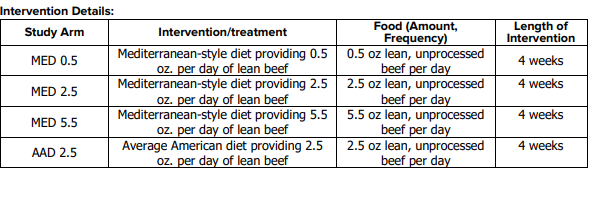
The objective of this study is to evaluate the effects of different quantities of lean, unprocessed beef (0.5, 2.5, 5.5 oz/day) as part of a healthy Mediterranean-style (MED) diet compared with an average American diet (AAD) containing 2.5 oz/d of lean, unprocessed beef on vascular-health endpoints.
Study Design
This was a two-site, randomized, crossover, controlled-feeding, weight maintenance trial with 59 participants. The participants (mean age: 49 ± 1.6 y; mean BMI: 27 ± 0.5 kg/m2) were generally healthy with multiple CVD risk factor measurements within healthy ranges at the start of the study. Every participant consumed each of the four diet treatments for four weeks, with at least a one-week break between diet periods (i.e., washout), in which participants resumed their self-selected diet.
Vascular outcomes, including blood pressure and arterial stiffness, were assessed at baseline and at the end of each diet period. Two different blood pressure measurements were taken: brachial and central. Brachial blood pressure is the most common blood pressure measurement—taken via pressure measured on the brachial artery on the front of the elbow. Central blood pressure, however, measures the blood pressure in the ascending aorta, just outside the heart. The central measurement is more intuitive because it is the blood pressure to which the heart and arteries are actually exposed. Arterial stiffness was measured via augmentation index and pulse wave velocity (PWV), where higher levels of these outcomes indicate stiffer arteries which can be a sign of cardiovascular issues.
All foods were provided during the diet treatment periods and participants were instructed to
consume only the foods provided and to limit their consumption of alcohol (2 drinks/wk) and noncaloric caffeinated beverages (<40oz/d). Diet intervention details are provided in Table 1 of the publication. Adherence was estimated to be >90%.
Mediterranean-Style (MED) Diets:
Each of the MED diets is composed of foods typically consumed in the United States, which included 7-oz equivalents of protein, of which 0.5, 2.5, or 5.5 oz (per 2000 kcal) is lean beef and the remainder from fish, poultry, pork, nuts, eggs, and/or legumes. All MED diets provided 250 mg/d EPA and DHA (long-chain polyunsaturated fatty acids) by varying the type of fish provided in each test diet. In addition, all MED diets contained <300 mg/d cholesterol, and <2,300 mg/d sodium. Authors note the MED diets were representative of the Mediterranean diet described by Fundación Dieta Mediterránea (https://dietamediterranea.com/en/nutrition/) and consistent with the Dietary Guidelines for Americans for dietary saturated fat and sodium.
The MED diets provided 41% calories from fat (8% from saturated fat, 25.5% from monounsaturated fatty acids, 7.5% from polyunsaturated fatty acids), 42% from carbohydrates and 17% from protein, with olive oil as the predominant fat source, 3-6 servings of fruits, and 6+ servings of vegetables a day. The unprocessed beef included in these diet periods was either lean or extra-lean. The
amounts of unprocessed lean beef for the MED diets were determined at 0.5 oz/d as the amount recommended in the Mediterranean diet pyramid, 2.5 oz/d as the amount an average American-beef consumer eats in a day and 5.5 oz/d as the amount which previous research connected with certain heart health benefits.1
The AAD provided 33% of calories from fat (12.5% from saturated fat, 13% from monounsaturated fatty acids, 8% from polyunsaturated fatty acids), 52% from carbohydrate, and 15% from protein and included 2.5 oz of lean unprocessed beef per day. Additionally, the AAD contained <300 mg/d cholesterol (same as MED diets) and ~3500 mg/d sodium (representative of the sodium content of an average American diet2).
Key Findings
Blood Pressures
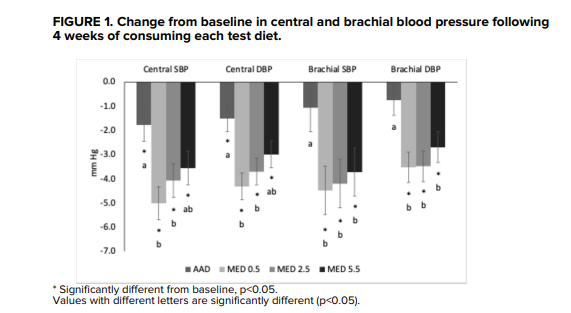
- From baseline, or the start of each diet period, brachial (both systolic and diastolic) and central blood pressures (both systolic and diastolic) and PWV all significantly improved with adoption of a MED diet with 0.5, 2.5, or 5.5 ounces lean beef per day, indicating a Mediterranean-style diet with up to 5.5 ounces of lean beef per day can improve measures of vascular function.
- Compared to the AAD, the MED diets all showed significantly greater improvements in brachial blood pressures (both systolic and diastolic).
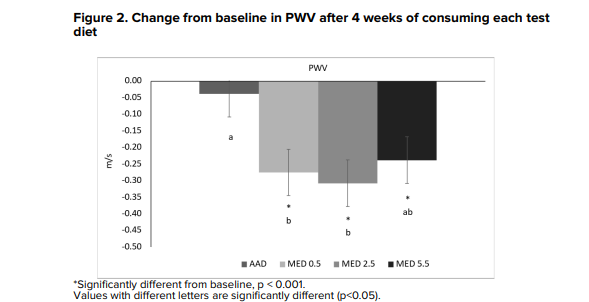
- Compared to the AAD, the MED 0.5 and MED 2.5 diets had significantly greater improvements in central blood pressures (both systolic and diastolic) and PWV. The changes in central blood pressure and PWV following the MED 5.5 diet were trending towards but were not a statistically significant improvement compared to the AAD.
- Improvements from baseline following consumption of the AAD for central blood pressure (both systolic and diastolic) may be an indication that the AAD in the study, though labeled “average”, was more balanced and healthful than the habitual diet study participants were following prior to the start of the study. For this reason, most results are discussed in the context of improvements from baseline, which shows the vascular health changes following adoption of the MED diets in comparison to participants’ habitual diets.
Arterial Stiffness
- There were no changes from baseline in augmentation index, a measurement of arterial stiffness, following 4 weeks of consuming any of the diets.
- Pulse wave velocity, another measurement of arterial stiffness and a predictor of adverse cardiovascular events, significantly improved from baseline following consumption of all three MED diets with lean beef, but no change was seen following consumption of the AAD.
ADDITIONAL RESULTS
- All study participants had normal blood pressure (117/77- brachial systolic/diastolic) prior to the start of the study, yet consumption of the MED diets containing lean, unprocessed beef still led to clinically relevant reductions in their brachial blood pressures.
- Following the MED 0.5, MED 2.5, and MED 5.5 diets, brachial systolic blood was lowered by −3.4, −3.1, and −2.7 mm Hg, respectively, and brachial diastolic blood pressure was lower by −2.8, −2.7, and −2.0 mmHg, respectively, compared to the AAD.
- These findings suggest that the health benefits of the MED diet with lean, unprocessed beef extend to individuals without elevated cardiovascular risk, highlighting its potential role in high blood pressure prevention as well as management.
- There is a linear relationship between blood pressure and incident CVD and therefore blood pressure lowering, even in the normal blood pressure range, is considered cardioprotective.
Study Implications
- Findings from this study demonstrate that eating a healthy Mediterranean-style dietary pattern with lean, unprocessed beef at levels greater than average beef intake in the U.S. (1.5 ounces per day)3 can support vascular health.
- This study builds on existing scientific evidence that moderate amounts of lean beef can be included in heart-healthy diets to support the improvement of numerous cardiovascular risk factors.4 Dietary guidance should focus on building healthy dietary patterns rather than restricting or eliminating specific foods such as lean, unprocessed beef
References
- Fleming JA, et al. Effect of varying quantities of lean beef as part of a Mediterranean-style dietary pattern on lipids and lipoproteins: a randomized crossover-controlled feeding trial. Am J Clin Nutr 2021;113(5):1126-36.
- https://www.fda.gov/food/nutrition-education-resources-materials/sodium-your-diet
- Lau CS, et al. Trends in Beef Intake in the United States: Analysis of the National Health and Nutrition Examination Survey, 2001-2018. Nutrients 2023;15(11):2475.
- Sanders LM, et al. Beef Consumption and Cardiovascular Disease Risk Factors: A Systematic Review and Meta-analysis of Randomized Controlled Trials. Curr Dev Nutr 2024;8(12):104500.
Citation
- Fleming JA, Petersen KS, Kris-Etherton PM, Baer DJ. A Mediterranean-style diet with lean beef lowers blood pressure and improves vascular function: secondary outcomes from a randomized crossover trial. Curr Dev Nutr 2025;9(4):104573.