Publication Summary
Beef Consumption is Associated with Higher Intakes and Adequacy of Key Nutrients in Older Adults age 60+ years: National Health and Nutrition Examination Survey 2011–2018 Analysis
- Principle Investigator(s):
- Sanjiv Agarwal1, Victor L Fulgoni, III2
- Institution(s):
- 1 NutriScience, LLC, East Norriton, PA 19403, USA
- 2 Nutrition Impact, LLC, Battle Creek, MI 49014, USA
- Publication Date:
- Nutrients, 2024 Download Summary
STUDY HEADLINE
Eating beef can help older adults improve nutrient intake and achieve adequacy for essential nutrients such as protein, calcium, zinc, thiamin, vitamin B12, iron, phosphorus, selenium and riboflavin in their diets.
Background
Adequate nutrition throughout the lifespan helps prevent chronic disease and supports healthy aging. The aging process is associated with physical, physiological, and cognitive changes in the body. Older adults are at greater risk for the development of chronic diseases and health conditions related to changes in muscle and bone mass. Although older adults generally have lower caloric needs as a result of a slowing metabolism and less-active lifestyles, their individual nutrient needs, such as protein and iron, are similar to or even greater than younger adults because of age-related changes in body composition and lower efficiency in absorbing and utilizing many nutrients. As shown in the figure below, a large percentage of the older adult population under consumes many nutrients, including vitamin D, choline, vitamin E, potassium, calcium, magnesium, vitamin C, vitamin A, zinc, vitamin B6, and folate. Additionally, vitamin B12 and protein are recognized by the Dietary Guidelines for Americans as nutrients of public health challenge for older adults. The inclusion of beef in an older individual’s diet can contribute important nutrients, including high-quality protein, highly bioavailable iron, zinc, choline, and B-vitamins.
Objective
To determine beef intake (including stratification by type: fresh beef (i.e., unprocessed), ground beef, and processed beef) and to assess the relationship with nutrient intake and nutrient adequacy in older adults (60+ years) using 24-h dietary recall data from the National Health and Nutrition Examination Survey (NHANES) 2011-2018, a comprehensive, nationally representative health and nutrition survey database.
Study Design
Dietary intake data from foods, reported via two 24-hour dietary recalls, of older adults 60+ years of age (n=5,868) participating in NHANES 2011-2018 cycles were combined to determine usual intakes of beef and nutrients, averaged together for the study population group. Usual food and nutrient intakes were determined using the National Cancer Institute (NCI) method1 and represent habitual intake over long periods of time. This is important because dietary recommendations are intended to be met over time, and diet-health relationships are often the product of long-term exposures, not a single eating occasion.
The Estimated Average Requirement (EAR) and the Adequate Intake (AI) for nutrients are established as cut points to estimate meeting nutrient adequacy for the majority of the population. The percent of the population that fell below the EAR (%< EAR) or the Adequate Intake (%< AI) for key nutrients were calculated to estimate nutrient inadequacy for the study population. The percent of the population above the EAR and AI cut points are meeting nutrient adequacy, thus meeting nutrient recommendations.
Beef consumption and nutrient intake are reported for two subpopulations: per capita and for beef consumers only. Beef consumer status was based on reporting any consumption of beef on either day of recall and reflects the average intake of these consumers only. Per capita intake reflects average beef intake calculated using data from both consumers and non-consumers of beef on either of the survey days.
Beef intake and nutrient adequacy was stratified by the type of beef consumed, including fresh (unprocessed) beef, ground beef, and processed beef but the categories were not mutually exclusive. For example, fresh ground beef, with no added ingredients, may fall under both fresh and ground beef categories. These results can be found in the Additional Results section below.
Results
Key Findings for Total Beef Intake:
- About 68% of older adults aged 60+ years consumed beef on at least one of the two days of dietary recall. The average beef intake among beef consumers was 56.1 g/day or 1.98 oz/day.
- Mean per capita beef intake was 38.3 g/day or 1.35 oz/day. This represents the total sample population of older adults, including both beef consumers and beef non-consumers.
- The 2020-2025 Dietary Guidelines for Americans recommends 3.7 ounces per day (for a 2,000-calorie diet) of meat, poultry and eggs in the Healthy U.S.-Style Dietary Pattern (HDP).
- Average beef intake of older adult beef consumers (1.98 oz/day) was well within the HDP recommendation for the Meats, Poultry, and Eggs Protein Foods Subgroup of 3.7 ounce-equivalents per day.
Key Findings for Nutrient Intake:
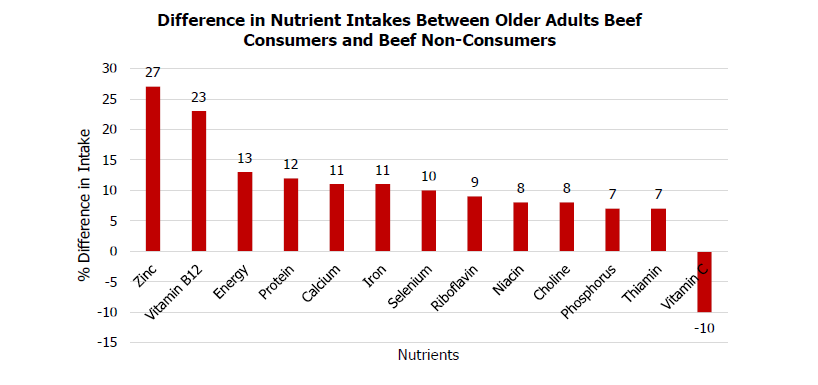
- Older adults who consumed beef had higher intake of 12 nutrients, including four nutrients of public health concern or challenge for this population, compared to those who did not consume beef. Beef consumers also had higher intakes of sodium and lower intakes of vitamin C, compared to beef non-consumers.
- Overall, a high percentage of all older adults do not meet daily recommendations for numerous nutrients. • Beef consumption helped more older adults meet nutrient recommendations for 11 nutrients in their total diets.
- Older adults who consume beef were more likely to meet nutrient recommendations for protein (+4% units), calcium (+12% units), copper (+5% units), zinc (+29% units), thiamin (+5% units), folate (+9% units), vitamin B12 (+11% units), iron (+3% units), phosphorus (+1% units), selenium (+2% units) and riboflavin (+2% units) as compared to beef non-consumers. Many of these nutrients are inherently available in beef.
- A higher proportion of beef consumers also exceeded the AI for sodium (+2% units) and failed to meet nutrient recommendations for magnesium (+7% units) and vitamin C (+7% units) than beef non-consumers.
- Energy intake for both sub-groups of the population was below or at the lower end of the recommended energy intake range for moderately active older adults (as noted in the 2020-2025 Dietary Guidelines for Americans). Beef consumers had 13% higher energy intake than beef non-consumers (2008 kcal/day vs 1775 kcal/day), which suggests beef consumption may help older adults meet caloric needs.
- Older adults who include beef in their habitual diets are more likely to meet nutrient adequacy targets for protein, calcium, copper, iron, phosphorus, selenium, zinc, thiamin, riboflavin, folate and vitamin B12, yet less likely to meet recommendations for magnesium and vitamin C compared to beef non-consumers.
- The 2020-2025 Dietary Guidelines for Americans specify protein and vitamin B12 as specific nutrients of public health challenge for this population, in addition to the nutrients of public health concern (vitamin D, calcium, dietary fiber, potassium) and nutrients of challenge (vitamins A, C, E and K, magnesium and choline) for all Americans.
- The study sample size of 5,868 in NHANES represents 63.6 million older adults, of which 43.5 million (sample size 3,796) were consumers of beef and 20.2 million (sample size 2,072) were non-consumers.
- Even just a 1% change in the proportion of older adults that meets a specific nutrient requirement can translate to about 435,000 more older adults with improved nutrient adequacy for that nutrient. To understand the impact, the number of older adults that would shift from inadequate to adequate can be calculated by multiplying the percent difference of consumer versus non-consumers that meet nutrient requirements for each nutrient by the population of non-consumers (20.2 million).
- For example, a decrease in the percentage of older adults below the EAR for zinc from 41.5% in non-consumers to 12.1% in consumers of beef suggest that nearly 6 million older adults would no longer be inadequate for zinc if they incorporated beef into their diet and consumed a dietary pattern similar to beef consumers in this study.
- Similarly, about:
- 810,000 additional older adult non-consumers would potentially be adequate for protein
- 2.3 million additional older adult non-consumers would potentially be vitamin B12 adequate
- 2.46 million older adult non-consumers would potentially be adequate for calcium
- 390,000 older adult non-consumers would potentially be adequate for riboflavin
- 980,000 older adult non-consumers would potentially be adequate for thiamin
- 970,000 older adult non-consumers would potentially be adequate for copper
- 1.84 million older adult non-consumers would potentially be adequate for folate
- The authors estimate that if older adults (age 60+ years) who were not consuming beef ate about 1.98 ounces of beef per day, a higher proportion of this population would be achieving nutrient adequacy targets (based on EARs) for protein, vitamin B12, calcium, riboflavin, thiamin, copper and folate
Additional Results
- The majority of older adults that consume beef choose to consume fresh or ground beef, with only about a quarter reported eating processed beef.
- About 60%, 39%, and 24% of older adults were consumers of fresh beef, ground beef, and processed beef, respectively, with corresponding mean intakes of 54.7 g/day (1.93 oz/day), 40.8 g/day (1.44 oz/day), and 23.6 g/day (0.83 oz/day).
- Mean per capita intakes of fresh beef, ground beef, and processed beef were 32.7 g/day (1.15 oz/day), 16.1 g/day (0.57 oz/day), and 5.62 g/day (0.20 oz/day), respectively.
- Across beef types (fresh beef, ground beef and processed beef), a higher proportion of beef consumers met nutrient recommendations for protein, calcium, iron, selenium, zinc and vitamin B12; a higher proportion of consumers had sodium intake above AI compared to respective beef non-consumers.
- A higher proportion of fresh and ground beef consumers also met nutrient recommendations for copper, phosphorus, thiamin, riboflavin, niacin and folate and potassium (only for ground beef) compared to the beef non-consumers.
- A lower proportion of processed beef consumers met nutrient recommendations for magnesium, vitamin C, vitamin D and potassium than beef non-consumers
Figure 1. Percentage of the Older Adults Who Do NOT Meet Recommendations for Various Nutrients
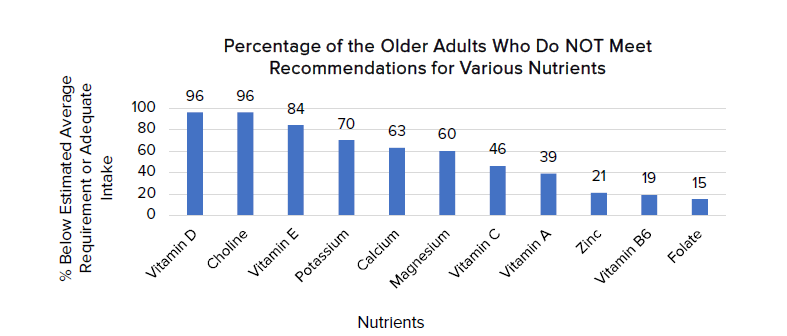
Figure 2. Difference in Nutrient Intakes Between Older Adults Beef Consumers and Beef Non-Consumers
References
- Herrick KA, Rossen LM, Parsons R, Dodd KW. Estimating usual dietary intake from National Health and Nutrition Examination Survey data using the National Cancer Institute method. National Center for Health Statistics. Vital Health Stat 2(178). 2018.
Citation
- Agarwal S, Fulgoni VL 3rd. Beef Consumption Is Associated with Higher Intakes and Adequacy of Key Nutrients in Older Adults Age 60+ Years: National Health and Nutrition Examination Survey 2011-2018 Analysis. Nutrients 2024;16(11):1779. doi:10.3390/nu16111779