publication summary
Beef Intake is Associated with Higher Nutrient Intake and Nutrient Adequacy in US Adolescents: NHANES 2001-2018
Author(s): Kristin Fulgoni & Victor L. Fulgoni III
Institution(s): Nutrition Impact, LLC
Publication: Nutrients, 2023
STUDY HEADLINE
In the adolescent population, beef consumption improves nutrient intake and helps a greater percent of the population meet requirements for iron, folate, riboflavin, thiamin, vitamins B12, zinc, calcium, copper, niacin, and phosphorus, contributing significantly to nutrient adequacy during this key developmental life stage, especially adolescent females who are particularly vulnerable to nutrient inadequacy.
Background
Adolescence is a critical life stage requiring additional nutrient needs for growth, development, and pubertal maturation. A combination of greater nutrient requirements and a decrease in diet quality at this age leads to a gap in the intake of key nutrients, creating a public health concern/crisis. Protein, zinc, B vitamins, and iron are a few of the essential nutrients of concern, among other vital nutrients being under consumed by both males and females in this population. The 2020 Dietary Guidelines for Americans state these key vitamins and minerals are lacking in the diet of young Americans, putting them at greater nutritional risk during rapid growth and development, the onset of puberty, menarche, and hormonal changes. Furthermore, adolescence is a unique life stage compounded by external factors that can impact diet quality, such as increased independence and food choice, peer pressure, restrictive eating and more. Along with poor diet quality (i.e., HEI score of 51) in adolescents, beef consumption of children and adolescents has significantly declined between 2001-2018. Animal proteins, and beef in particular, provide essential amino acids and a gamut of nutrients unique to animal-sourced foods, such as vitamin B12 and bioavailable heme-iron. At a time when there is a global public health concern regarding adolescent nutrient inadequacies, it is critical to understand current beef intake and the role beef can play in helping to meet nutrient needs during this key life stage.
Objective
To determine average total beef intake and assess the relationship between beef consumption and nutrient intake and adequacy in male and female adolescents, 14–18 years of age. In addition, to compare nutrient intake and adequacy differences between adolescent beef consumers and non-beef consumers using data from NHANES 2001-2018.
Study Design
Dietary intake data of adolescents 14-18 years of age from National Health and Nutrition Examination Survey (NHANES) 2001-2018 cycles were assessed. Total beef and nutrient intakes were quantified based on the beef content of NHANES survey foods reported in the two dietary recall and associated nutrients from USDA nutrient files. The National Cancer Institute method was used to estimate usual intakes and distribution of intakes of beef and nutrients. Intake was measured in terms of total beef, without further consideration of fresh, lean, or processed beef.
Nutrient adequacy was calculated using the percentage of the population below the estimated average requirement (EAR) or above the adequate intake (AI). Dietary supplements were not included in the intake data.
Beef consumers and non-beef consumers were identified based on whether the participant reported consuming beef on day 1 or day 2 of the diet recall.
Key Findings
- Regular beef consumption helps a greater percentage of the adolescent population meet nutrient adequacy for iron, folate, riboflavin, thiamin, vitamins B12 and B6, zinc, calcium, copper, niacin, and phosphorus, contributing significantly to nutrient adequacy during this key developmental life stage, especially adolescent females who are particularly vulnerable to nutrient inadequacy.
- Total beef intake significantly improved nutrient adequacy of adolescent females (i.e., fewer percent falling below the EAR) for calcium (-13%), copper (-16%), folate (-17%), iron (-14%), niacin (-4%), phosphorus (-25%), riboflavin (-8%), thiamin (-11%), vitamin B12 (-20%), vitamin B6 (-11%) and zinc (-46%).
- Total beef intake significantly improved nutrient adequacy of adolescent males (i.e., fewer percent falling below the EAR) for calcium (-24%), copper (-13%), folate (-13%), iron (-9%), phosphorus (-25%), riboflavin (-8%), thiamin (–9%), vitamin B12 (-(11%), vitamin B6 (-9%), zinc (-51%).
- Fewer male and female adolescent beef consumers were nutrient inadequate (i.e., fell below the EAR) for numerous nutrients, particularly for those inherently found in beef, such as iron, niacin, phosphorus, riboflavin, thiamin, vitamin B12, vitamin B6, and zinc, when compared to those in the same age group who did not consume beef.
- Adolescents are challenged with significant nutrient gaps during a period of rapid growth and development. A considerable portion of the adolescent subpopulation (including both beef consumers and non-beef consumers) do not meet recommendations for many essential nutrients, with more than half falling below the EAR for calcium, magnesium, and vitamins A, C, D, and E and over 70% below the AI for potassium and total choline.
- This study also indicates that dietary patterns, aside from the sole presence of beef, differ between beef consumers and non-beef consumers. Many of the highlighted essential nutrients in this study are inherently available in beef (e.g., iron, riboflavin, vitamins B12 and B6, zinc, niacin, phosphorus, and copper), while others are contributed from foods eaten with beef or present in the total diet (e.g., calcium, folate).
- The current study found beef consumers had upwards of 15% more intake of calcium, iron, phosphorus, selenium, sodium, total choline, vitamin B12, and zinc than non-consumers.
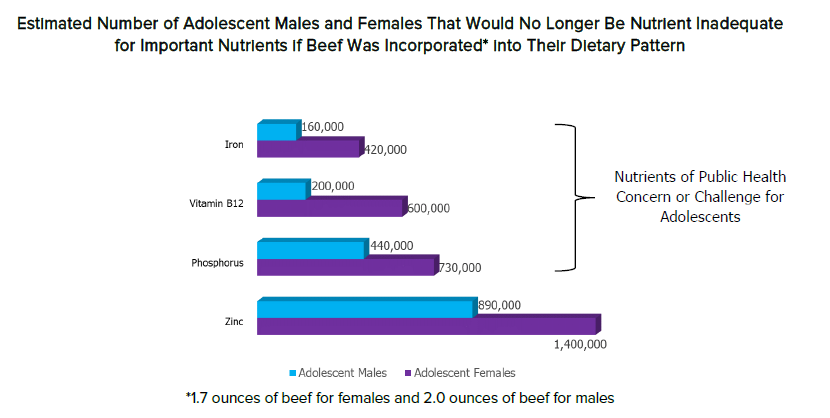
- As shown in the Figure 1., it is estimated that 1.4 million, 730,000, 600,000, and 420,000 fewer adolescent females would fall below EAR for zinc, phosphorus, vitamin B12, and iron, respectively if they incorporated an average of 1.7 ounces of beef into their dietary pattern. Similarly, it is estimated that 890,000, 440,000, 200,000, and 160,000 fewer male adolescents would fall below the EAR for zinc, phosphorus, vitamin B12, and iron, respectively, by incorporating an average of 2 ounces of beef into their dietary pattern.
Additional Results
- Female adolescents who consumed beef had an average total beef intake of 46.8 grams (1.7 ounces) per day.
- When compared to adolescent females who did not consume beef, adolescent girls who consumed beef reported numerically higher intakes of 19 out of 20 vitamins and minerals considered. Statistically higher intakes were reported for 13 nutrients, specifically, calcium, folate, iron, niacin, phosphorus, potassium, riboflavin, selenium, sodium, thiamin, total choline, vitamin B12, and zinc.
- Total beef intake significantly improved nutrient adequacy of adolescent females (i.e., fewer percent falling below the EAR) for calcium (-13%), copper (-16%), folate (-17%), iron (-14%), niacin (-4%), phosphorus (-25%), riboflavin (-8%), thiamin (-11%), vitamin B12 (-20%), vitamin B6 (-11%) and zinc (-46%).
- Male adolescent beef consumers had a 24% greater beef intake when compared to females, equating to 57.9 grams (2.0 ounces) per day.
- When compared to adolescent male non-beef consumers, adolescent boys who consumed beef had numerically higher intakes of all 20 vitamins and minerals reported in the study. Statistically higher intakes were reported for 11, specifically, calcium, iron, niacin, phosphorus, potassium, selenium, sodium, thiamin, total choline, vitamin B12, and zinc.
- Total beef intake significantly improved nutrient adequacy of adolescent males (i.e., fewer percent falling below the EAR) for calcium (-24%), copper (-13%), folate (-13%), iron (-9%), phosphorus (-25%), riboflavin (-8%), thiamin (–9%), vitamin B12 (-(11%), vitamin B6 (-9%), zinc (-51%).
Figure 1.
Citation
- Fulgoni, K.; Fulgoni, V.L., III. Beef Intake Is Associated with Higher Nutrient Intake and Nutrient Adequacy in U.S. Adolescents, NHANES 2001–2018. Nutrients 2023, 15, 4996. https://doi.org/10.3390/nu15234996